Call: (08) 9250 4575
8.30 - 4.00 Monday - Friday
8.30 - 2.00 Saturday
(closed Sunday)
Perth gardening advice and exclusive offers: Subcribe to our Newsletter

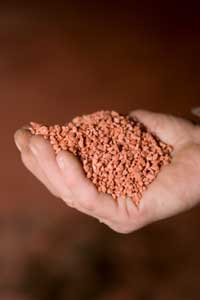 Most minerals and fertilisers need to be broken down by microbial activity in the soil before they can be utilised by plants, which is why adding them to compost piles, or incorporating into the soil when adding organic matter is highly recommended.
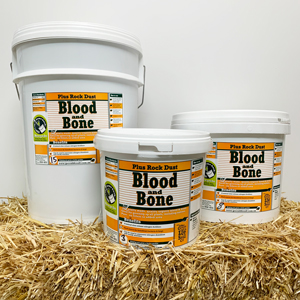
We are now selling many of our mineral products in polypropylene tubs. Many of these tubs are manufactured right here in WA (saving shipping & fuel). There are generally 2 or 3 tub sizes available. The tubs make great containers around the house, but we encourage you to return them to us when you need to buy more product. We can refill them and you will only pay by the kilo for your minerals; saving money and recycling packaging.
 When the containers have eventually reached the end of their usable life, they are recyclable by your local council service in your yellow topped bin - so together we can keep precious resources from ending up in landfill!
This refill & recycle initiative saw us selected as a Finalist in the 2012 Infinity Awards (Business Category).
Certified Organic. Smart Watermark Approved & Waterwise accredited. The natural way to improve water repellent soils. Holds water and nutrients by using natural minerals. Replaces the need for chemical soil wetting products. More information on Sand Remedy can be found at www.sandremedy.com.au
Available in 5kg or 20kg tubs.
Highly absorbent mineral that has applications for gardens & pet care. Our DE is animal foodgrade - it is a raw mineral product, and as we are a soil yard, it is not produced or stored in a way to be deemed human food grade. However, it is completely untreated and non-toxic to humans and animals.
More information on Diatomaceous Earth.
Available in 5L, 10L and 20L tubs or by per kg.
Add to clay soils to improve drainage and root penetration. Adds calcium. pH neutral.
Available in 1kg sachet and 20kg bags or by per kg.
Raises the pH of acidic soil. Adds calcium. A good additive to worm farms.
Available in 1kg sachets and 4kg tubs, and 25kg bags.
Available in 1kg sachets, 5kg, 13kg and 20kg tubs or by kg.
Available in 1kg sachets and 5kg tubs, and 25kg bags.
Available in 1kg sachets and 25kg bags, or by kg.
Available in 5kg tubs & 15L bags or by kg.
Available in 5kg tubs and 20kg bags or by kg.
Available in 15kg bags, 500L & 1000L bulkabags, or in bulk.
A super fine grade of kaolin clay (~99% clay) used in paper production. This fine grade can be mixed with water and used as a topical spray for fruit trees and vegetable crops to protect against sunburn, and as an aid in controlling some insect pests. Clay coating on the plant forms a barrier that is unappealing/difficult for insects to break through.
Available in 500gm packs and other sizes by arrangement.
Available in 1kg and 5kg tubs, and 25kg bags.
Available in 3kg, 7kg and 15kg tubs.
Available in 25L bags, 500L and 1000L bulkabags, or bulk.
The range of natural minerals and rock dusts we sell are all natural products and are non toxic. However, inhalation of any fine dust over a prolonged period without using respiratory protection may cause lung disease (eg. silicosis). When using any mineral product, avoid using in windy conditions, and wear a dust mask when applying to protect from inhalation.
Rock dust is made from finely ground up rocks; it is a by-product of rock crushing and polishing. It is usually a mixture of granite and basalt rocks. The benefit of having such a fine powder enables soil microbes and chemicals to break the minerals down, meaning faster availability for plants.
This rock dust provides: Nitrogen, Phosphorous, Potassium, Calcium, Carbon, Magnesium, Sulphur, Silicon, Iron, Copper, Zinc, Manganese, Boron, Cobalt, Molybdenum and Selenium in a balanced, slow release form.
What does it do?
Rock dust replaces minerals which have been used up or leached from poor and overworked soils. Users of rock dust have noted the following benefits:
Rock dust is less soluble than artificial fertilisers and stays active in the soil for some time. We recommend using twice a year only, at a rate of approx. 50gm - 100gm per m2. After 3 years of application, remineralisation need only be done every 3 years.
Over application can lead to increased soil alkalinity. Remember that trace elements are important, but plants only require a very tiny amount.
Rock dust works best in conjunction with good organic soil building, and can be added to compost piles and worm farms.
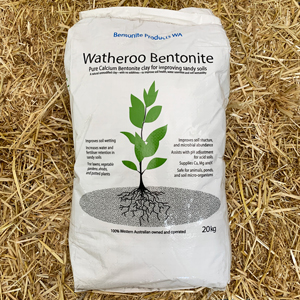
Bentonite is a type of clay believed to be formed from decomposed volcanic ash – made from the minerals Montmorillonite and Beidellite (just in case you really wanted to know!). It is used in many industries for loads of different tasks – from sinking oil wells, to dam lining to kitty litter manufacture.
Essentially, it is of interest to gardeners due to its water holding ability. It is useful in binding soil particles together to create a crumb structure.
Bentonite needs to be worked into the top 100 - 200mm of soil. Use at a rate of 1 - 4kg per m2 on coarse sandy soils; the general rule being the poorer the soil, the more Bentonite to use. Use less in soils with a higher humus content, or in gravelly loam. Bentonite can be added in several applications over a period of time, if you are unsure try a lesser amount to begin with (you can always add more but over application can cause a big problem!).
We always recommend incorporating organic matter in addition to water holding minerals, as part of a complete soil improvement process.
*Note – we recommend ‘Sand Remedy’, which is a pre-mixed product ready to use on your garden in place of soil wetting agents. It has a range of other minerals added, as well as trace elements, beneficial microbes, and a food source for them. It is designed for maximum efficiency, performance and ease of use.
Produced through volcanic activity, Zeolite is a very porous mineral used in industry as a filtering agent for water, as a stockfeed supplement and in horticulture as a soil additive.
Due to its porous nature, each particle has a large surface area, enabling what is known as ‘cation exchange’ to take place. This means that Zeolite can hold and exchange nutrients required by plants, making nutrients readily available.
It can be worked into the top 100 - 200mm of soil, or added to compost piles. Use at a ratio of:
Otherwise known as hydrated calcium sulfate, Gypsum occurs as a saline evaporite mineral from ancient watercourses (similar to limestone). It is a major industrial mineral used in products from paper to paint, and also as a food additive.
Gardeners are interested in its applications as a clay breaker, helping to improve structure and increasing the infiltration of air and water through the soil. It also allows plant roots to penetrate, alleviating compaction.
Gypsum is pH neutral and is a useful source of calcium.
Application: Not all clay soils will respond to gypsum. To determine whether your soil will respond, drop a piece of dry clay approx. 6mm across into a glass of water. Do not move the glass – just leave it for an hour, then 24 hours. If it slowly disperses into the water, first forming a halo around the piece, it will respond to the addition of gypsum. The greater the cloudiness of the water and the more rapidly the clay disperses, the more gypsum will be required. If however after 24 hours the particle has done nothing at all in the water, it will be a waste of time adding gypsum.
Gypsum should be added at a rate of ½ - 1kg per m2, digging into the soil. It is also beneficial to add organic matter to continue to improve the soil structure.
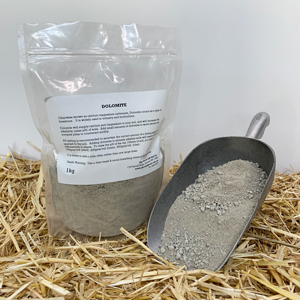
Otherwise known as calcium magnesium carbonate (calmag), Dolomite occurs as a type of limestone. It is widely used in industry and horticulture.
Dolomite will supply calcium and magnesium to your soil, and will increase the alkalinity (raise pH) of soils. Add small amounts of dolomite to worm farms and compost piles to counteract acidity.
PH testing is recommended to ascertain the correct amount of a liming agent to be applied to the soil. Adding dolomite to already alkaline soils will result in nutrient deficiencies in plants.
To raise the pH of the top 100mm of soil, use dolomite as below (grams/m2)
Soil type:
It is better to add a little often rather than one large dose.
Sulfur/sulphur occurs in craters of extinct volcanoes, and is produced in association with hot springs (that rotten egg gas smell!). It is used in many products from match heads to rubber, and is useful in horticulture as a fungicide, insecticide and soil remedial agent.
Sulfur is used to raise the acidity (lower pH) of a soil. In extremely alkaline soils, it is more economical to use sulfur in addition to naturally acidic mulch such as pine needles or cedar shavings. Adding organic matter will naturally help to lower pH – but quite gradually.
To lower the pH of the top 100mm of soil use sulfur as below (grams/m2)
Soil type:
Note that it will take some weeks to take effect. For a quicker result, use Chelated Iron which is mixed with water and applied with a watering can.
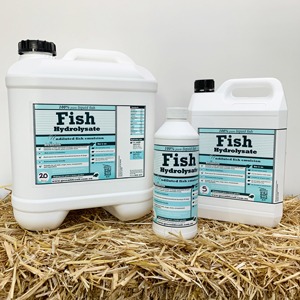
As sulphur is a natural fungicide, it can have a detrimental effect on soil microbiology. Boost with microbes, microbial food sources (eg. fish hydrolysate), add compost, etc.
For another option to permanently lower your high pH soil - we recommend Charlie Charcoal; which helps to provide habitat for beneficial microbes.
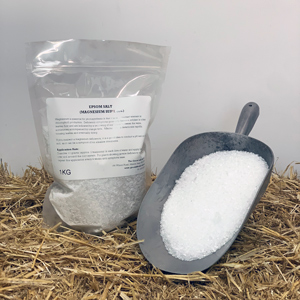
Magnesium is essential for photosynthesis in that it is an important element in chlorophyll production. Deficiency symptoms generally become evident in older leaves first and are indicated by a yellowing of leaf tissue between the veins, sometimes accompanied by orange tints. Affected plants deteriorate rapidly, loosing leaves and eventually dying.
If you suspect a magnesium deficiency, it is a good idea to conduct a pH test on the soil, as it can be a symptom of too alkaline conditions.
Dissolve 10 grams (approx. 2 teaspoons) in each litre of water and apply liberally over soil around the root system. For plants showing severe deficiency symptoms, repeat this application every 4 weeks until symptoms ease.
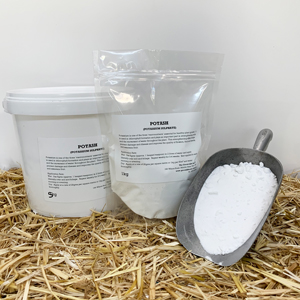
Potassium is one of the three ‘macronutrients’ essential for healthy plant growth. It is used in chlorophyll formation and plays an important part in strengthening cells and the movement of water throughout the plant. This strengthening effect helps prevent damage and disease and improves the quality of flowers, fruit and seeds.
Sulphate of Potash also contains sulphur, but not in a form that will lower pH.
Wet: Use 5gms (approx. 1 heaped teaspoon) in 2 litres of water and apply liberally over soil and foliage. Repeat weekly for 3-4 weeks. Best applied in early morning or evening.
Dry: Apply at a rate of 20gms per square metre or 1kg per 50m2 and water thoroughly.
Spongolite is actually ancient, fossilised sea sponges. It is used in agriculture, to capture industrial spilled liquids, in cat litter, fire retardant products, and thermal insulation. There are very large deposits of this mineral near Esperance and Mt Barker within Australia, and in Brazil.
Spongelite is comprised of almost 99% silica, Silica plays a very important role in strengthening cell structure in plants, making them less susceptible to pest and disease attack. It also aids in healthy flower and fruit production.
Spongolite is very lightweight and extremely porous. It has a natural ability to hold onto water. The sponge structure is silica based and very strong, which means it does not tend to break down quickly. In horticulture, it is used in potting mixes and garden beds to help with water retention. Containing silica, it is abrasive and care should be taken to avoid breathing dust particles (its needle like structure is similar to asbestos).
It can be worked into the top 100 - 200mm of soil, or added to compost piles. The required amount of Spongolite will vary greatly depending on how poor your soil is. The general rule is the poorer the soil, the more Spongolite may be required.
We suggest an application rate of between 250gms - 1kg per m2. (If in doubt, try a smaller amount and re-apply if required.) In potting mix, allow a ratio of between 2 - 10% of total volume.
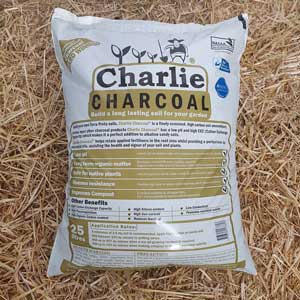
'Charlie Charcoal' high quality horticultural charcoal is in fact, a type of biochar.
Biochar can be made from any number of waste materials put through a special pyrolysis burner, which keeps the waste at a very high temperature for an extended period. Carbon produced in the process is captured and stored in the biochar (it is a carbon negative process). (Charlie Charcoal is made from high grade wood waste.)
Biochar provides large amounts of carbon, which lasts much longer than compost does (although they both have important roles in soil improvement). It is also highly absorbent so will help with water holding in sandy soil. It also provides a habitat and food source for beneficial microbes.
Add Biochar to compost bins, and "super charge" it with water and liquid fertiliser prior to applying to your garden. (To do this, mix up your liquid fertiliser, then add your Charlie Charcoal. Fill bucket with water and leave to soak for a couple of hours.)
Unlike many types of biochar, Charlie Charcoal has a very low pH, and will help buffer alkaline soils on a permanent basis.
A minimum of 2-5 lts / m² is recommended. Apply higher rates on sandy soils (up to 10L / m²).
Turn into the top 100 mm of soil.
Add between 10% by volume to potting mixes.
Add up to 40% by volume when a low pH growing medium is required.
Add up to 10% by volume when making compost to support microbial activity.
Note: The Australian Government Australian Pesticides and Veterinary Medicines Authority have advised that Green Life's DE is not registered under the Agricultural and Veterinary Chemicals Code Act 1994 ('Agvet Code') and as such it is an offence to represent it as a product which: "is represented as a means of destroying, stupefying, repelling, inhibiting the feeding of, or preventing infestation by or attacks of, any pest in relation to a plant, a place or thing and/or modifying the physiology of a plant or pest so as to alter its natural development, productivity, quality or reproductive capacity."
We are allowed to tell you that insect pests don't seem to like it much.
If you are looking at information about how people around the world have used DE, please Google it or consult organic gardening books, websites or forums.
Diatomaceous earth is made from the remains of tiny single celled algae called diatoms, which make shells for themselves out of silica. When the diatoms die, the shells settle on the bottom of sea or lake beds and fossilize into a soft, chalky rock like substance. There are many DE deposits around the world which are mined for use in industry and agriculture.
It is naturally extremely absorbent.
DE’s microscopic structure consists of many sharp edges.
DE can be dusted, sprinkled, raked, mixed with water and sprayed over plants or around the house and garden DE will continue to work as long as it is present in the environment.
DE is also useful sprinkled in & around chook pens, kennel areas, etc. It will deodorise and absorb odours from these areas. Food grade DE is not poisonous to humans or animals. DE can be used in the garden, or inside the house.
DE is composed of silica, but also contains other trace minerals. When used in soils, it aids in:
- Increases water holding capacity, and aids nutrient
retention
- Encourages beneficial microbial soil activity
- Boosts plant tissue strength, meaning more pest and disease resistance
- Converts locked up phosphorous into a plant available form
- Decreases soil salinity by diluting sodium content
DE is a beneficial addition to compost heaps. It aids with controlling odours It will not harm earthworms, provided it is sprinkled on the top of the soil to allow worms to slowly digest it and work it in.
Use only food grade DE. Pool filtered DE is chemically treated and is poisonous.
Our DE is Animal Food Grade (but not recommended for human consumption).
Care should be taken when using DE. Wear a dust mask, eye protection and gloves. While it is non toxic the tiny particles can be drying to skin and hands, and harmful if inhaled. Always wash hands after use.
| Shopping cart is empty. |




OPEN 6 DAYS
Monday - Friday 8.30am - 4.00pm
Saturday 8.30am - 2.00pm
Closed Sundays